149071 stories
·
1 follower

How Google AI Overviews, AI Mode and Gemini Differ

1 Share

Much of the confusion around AI search starts with Google's own products. Ask ten people to explain the difference between Google AI Overviews, AI Mode and Gemini, and you will often get ten different answers. That confusion is understandable. The products overlap. They use the same family of Gemini models. They all answer questions. But they are not the same experience, they are not used the same way, and they should not be measured the same way - and if you mix them together, it becomes much harder to understand AI-search behavior, traffic and visibility.
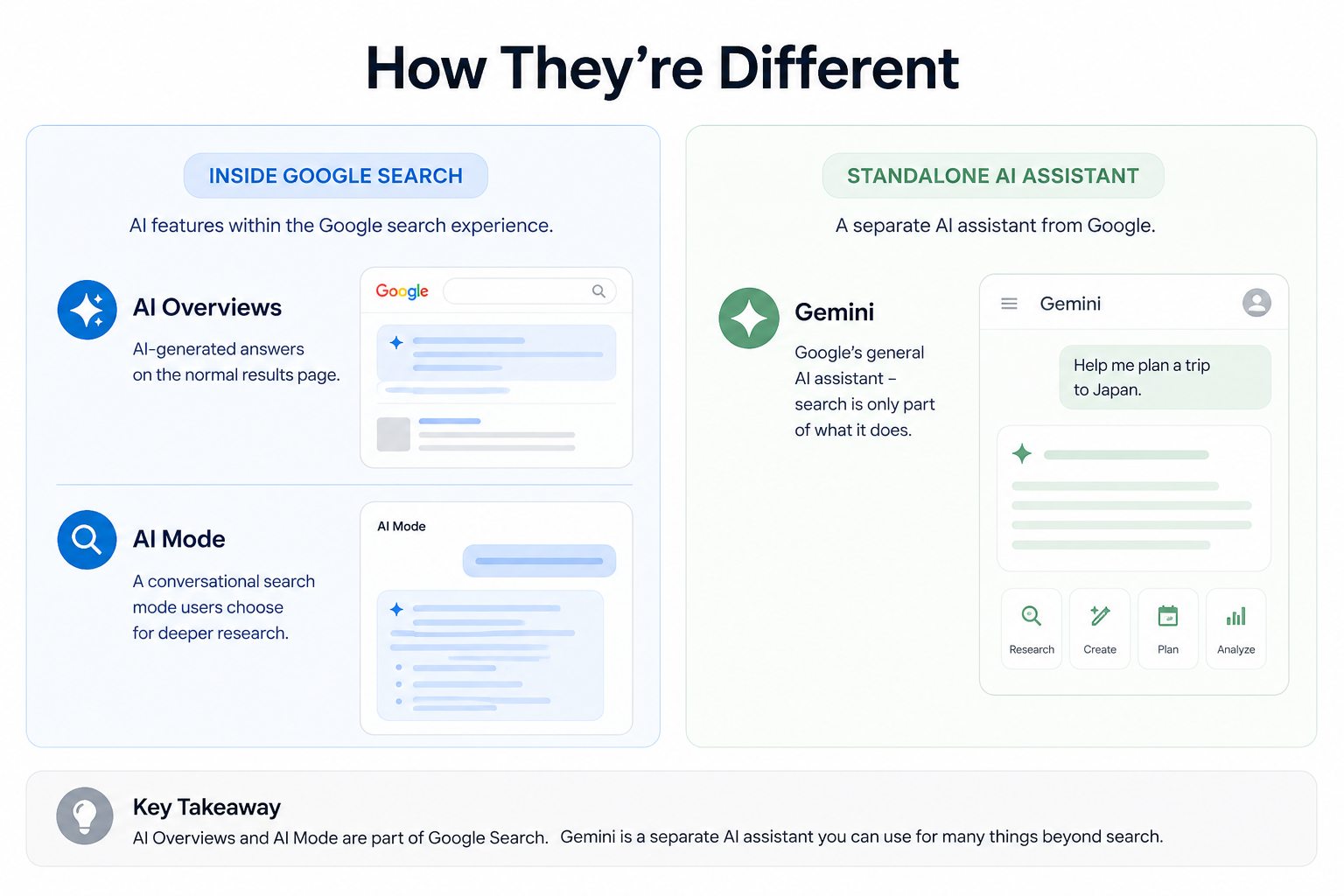
Comparison graphic showing how Google's AI products differ: AI Overviews and AI Mode are features inside Google Search, while Gemini is Google's standalone AI assistant

The simplest way to explain the difference

AI Overviews is an AI answer placed inside a normal Google search results page.

AI Mode is Google's more conversational, research-oriented search experience.

Gemini is Google's standalone general AI assistant, which can help with research but also many non-search tasks.

Our estimated monthly U.S. search-like activity

Modeled estimates, not platform-reported totals. How each was built is shown in its section below.

~64B

Google AI Overviews - U.S. searches per month showing an AI Overview

~3B

Google AI Mode - search-like prompts per month (U.S.)

~1.4B

Gemini - search-like prompts per month (U.S.)

Why the distinction matters

The difference matters because these products represent different user intents, different surfaces, and different ways information is discovered and presented.

AI Overviews

Appears in ordinary Google searches

Piggybacks on traditional Google Search volume. Users may not even consciously decide to use an AI product. They simply search on Google and receive an AI answer.

AI Mode

Users choose it for deeper research

A much clearer signal of research intent. The user is opting into a more back-and-forth experience, often for comparisons, planning or complex decisions.

Gemini

Used for search and many other tasks

Spans far more than search. It can be used for questions, but also brainstorming, writing, organizing, multimodal tasks and assistant-like help across Google surfaces.

Why this is so confusing in practice

All three products use Gemini technology, but they are different user experiences. That is why it is easy to hear that "Gemini is growing," "AI Mode has passed 1 billion users," and "AI Overviews reaches 2.5 billion users," and mistakenly assume those are three versions of the same metric. They are not.

Search is changing, but not in one simple direction

The evidence does not suggest that traditional Google Search has suddenly disappeared. Google says it processes more than 5 trillion searches a year, and at I/O 2026 the company said Search query volume had reached an all-time high. What is changing is the shape of the experience around those searches.

AI Overviews now reaches 2.5 billion monthly users. AI Mode has passed 1 billion monthly users. And the Gemini app has passed 1 billion monthly users. So the right story is not that search is simply moving away from Google. It is that Google's own ecosystem is splitting into multiple AI-mediated ways to search, research and get answers.

Google AI Overviews
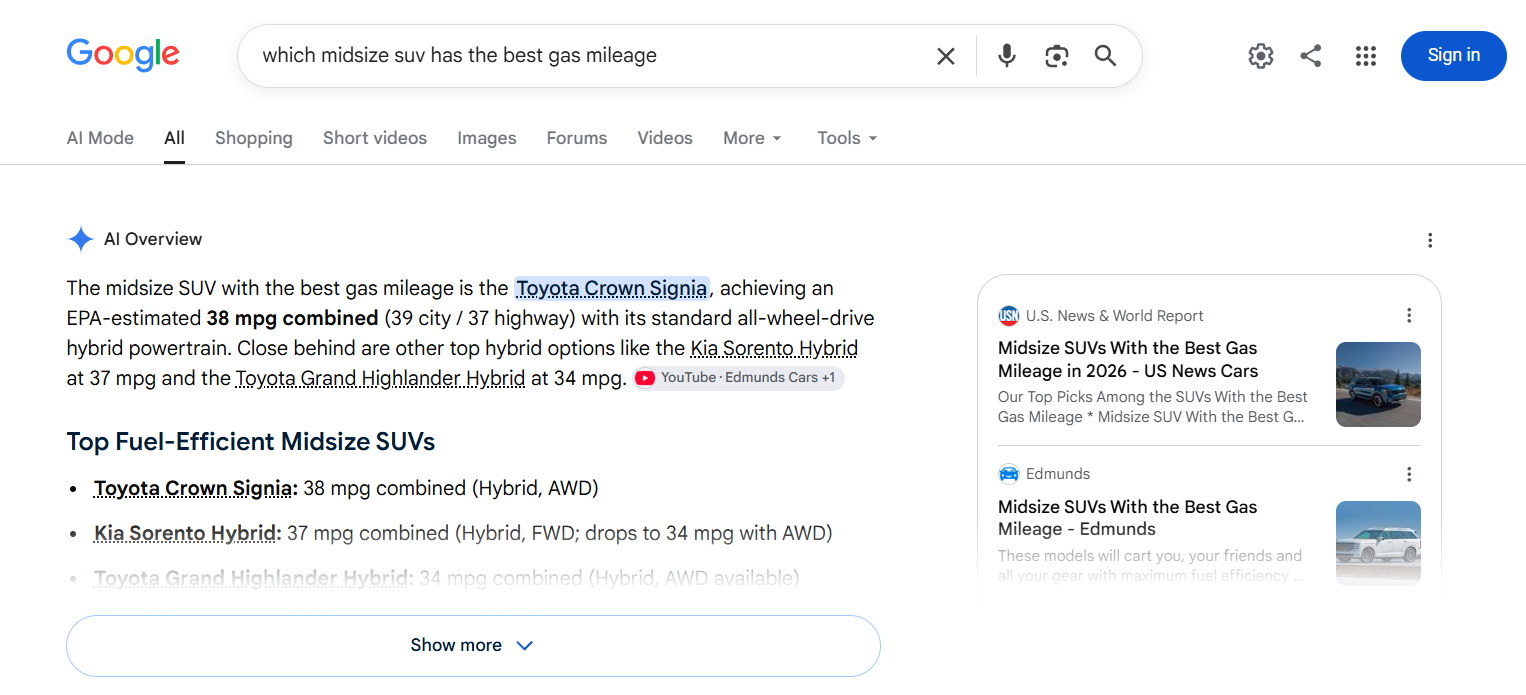
Google AI Overview shown inside a Google search results page for a midsize SUV gas mileage question

Screenshot example of a Google AI Overview appearing inside an ordinary Google search results page.

What it is: AI Overviews is Google's AI-generated summary inserted directly into the standard Google Search results page when Google decides an answer would be helpful.

How people access it: By doing a normal Google search on web or mobile. There is no separate app or destination required.

Typical user intent: Quick synthesis, answer-first information gathering, and lightweight research.

Relationship to Search: It is a feature inside Google Search, not a separate search engine.

Why it feels different from classic Google: Instead of immediately scanning the traditional results, the user may see a synthesized answer before or alongside those links, so discovery can happen before any organic click.

What to remember: AI Overviews is a subset of Google Search, not a separate demand pool. It does not represent extra searches. It represents Google searches where the results page itself now contains an AI-generated answer.

How we estimated it

~80B U.S. Google searches per month (Google's 5-trillion-plus annual disclosure × a 19% U.S.-share proxy, our assumption) × ~80% of searches showing an AI Overview (Search Engine Roundtable, October 2026)

~64B

U.S. searches/month
showing an AI Overview

The ~80B denominator is a floor: the 5-trillion disclosure dates to 2025, and Google says search volume has grown since.

Key sources: Google 5T+ searches, Google I/O 2026, Search Engine Roundtable: over 80% of Google searches have AI Overviews.

Google AI Mode
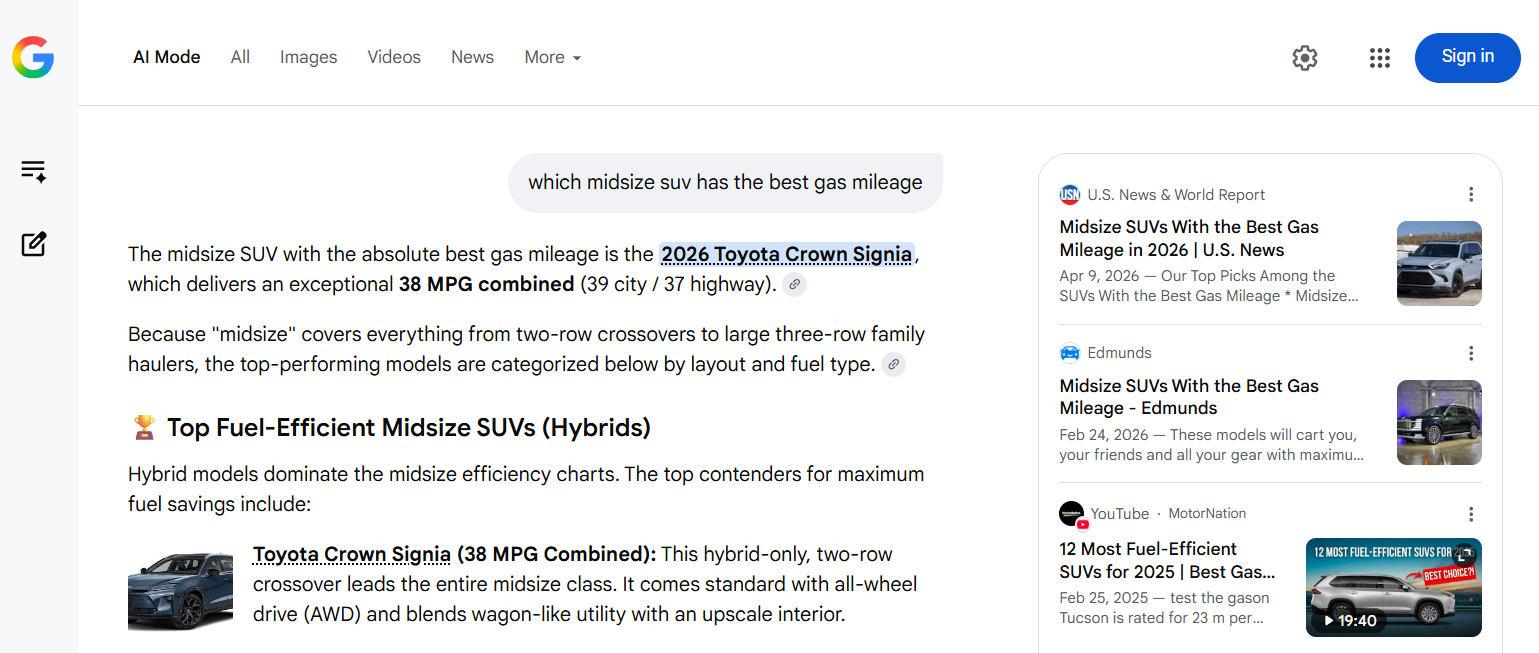
Google AI Mode answering a car shopper's question in a conversational search interface

Screenshot example of Google AI Mode answering a shopper's question in a conversational search experience.

What it is: AI Mode is Google's dedicated conversational search interface. It is still part of Google Search, but it is designed for deeper exploration, follow-up questions and more complex research journeys.

How people access it: By choosing AI Mode in Search directly, or by continuing from AI-powered search results into deeper follow-up research.

Typical user intent: Comparison, planning, exploratory research and back-and-forth discovery.

Relationship to Search: It is a search-native conversational mode, closer to a research session than a standard results page.

What makes it different from AI Overviews: AI Overviews answers a search inside the existing results page. AI Mode invites the user into a separate, multi-turn research flow - the clearest sign that Google wants Search to become more conversational, not just more summarized.

The average AI Mode query is roughly 3x longer than a traditional search

Typical Google search

best midsize SUV

Typical AI Mode query

What are the best three-row SUVs for a family under $50,000, and which have the best second-row space?

The 3x query-length figure is reported by Google; the example queries are illustrative.

How we estimated it

~280M U.S. AI Mode web visits per month (Similarweb) × a 4x all-surface multiplier for the app and mobile usage Similarweb does not measure (our assumption) × ~2.7 prompts per session (Similarweb)

~3B

U.S. search-like
prompts/month

Less certain than the AI Overviews estimate: Google reports monthly users, not prompt volume, and the 4x multiplier is this estimate's biggest assumption. Directionally, it points to a very large and rapidly growing research surface.

Key sources: Google I/O 2026, Similarweb 2026 Generative AI Landscape Report.

Google Gemini
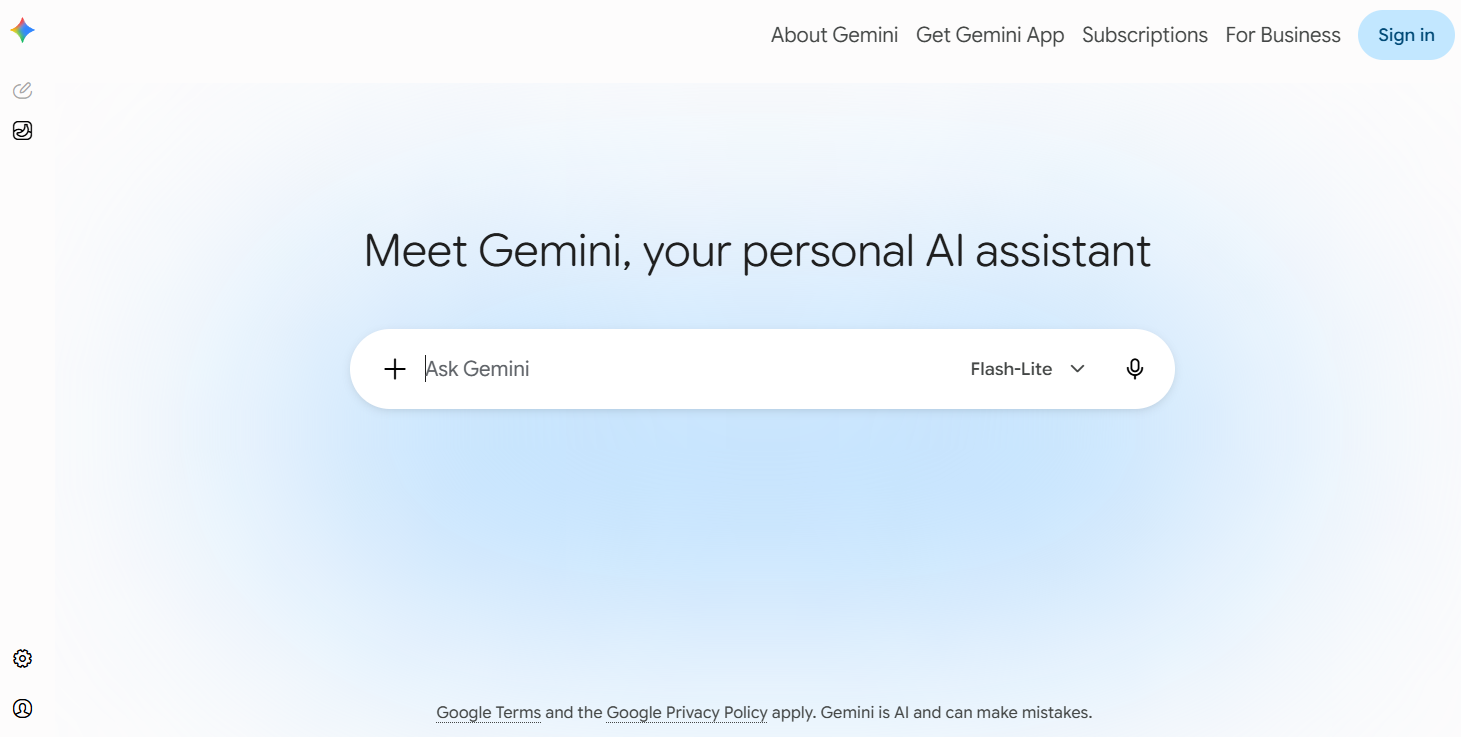
Google Gemini web interface, a standalone AI assistant

The Gemini web interface. Gemini is a standalone assistant experience rather than just a Search feature.

What it is: Gemini is Google's standalone AI assistant. It can handle research questions, but it also supports writing, planning, creation, multimodal tasks and assistant-like help across apps and devices.

How people access it: Through the Gemini app, <a href="http://gemini.google.com" rel="nofollow">gemini.google.com</a>, Android and other Google product integrations.

Typical user intent: A mix of research, personal assistance, content creation and general problem solving.

Relationship to Search: Gemini can behave like a search assistant, but it is not limited to search behavior.

Why this gets confusing: AI Mode is explicitly a search experience; Gemini is a broader assistant. And because Google uses Gemini models across several products, people often blur the model, the app and the Search experiences into one thing.

This distinction matters when comparing usage. Google announced that the Gemini app has passed 1 billion monthly users, but that does not tell us how many of those interactions are truly search-like. A person can use Gemini to summarize notes, rewrite copy, generate ideas, or ask factual questions. That is why "Gemini users" cannot be treated as "Gemini searches."

How we estimated it

~325M U.S. Gemini web visits per month (Similarweb) × a 4x all-surface multiplier for app and mobile usage (our assumption) × ~2.1 prompts per session (Similarweb) × a 52% search-like share (our assumption - Google publishes no Gemini intent split)

~1.4B

U.S. search-like
prompts/month

A directional estimate rather than a platform-reported number: both the all-surface multiplier and the search-like share are assumptions, making this one of the more uncertain figures in the model.

Gemini beyond Google's own apps

Apple and Google announced a multi-year collaboration in which future Apple Foundation Models will be based on Google's Gemini models and cloud technology, including models intended to help power a more personalized Siri. That does not mean Siri becomes the Gemini app, but it does suggest Gemini technology will influence an even broader set of user experiences.

Key sources: Gemini 1B monthly users, Google and Apple joint statement, Similarweb 2026 Generative AI Landscape Report.

Side-by-side: the clearest way to remember the differences

Estimated search-like activity

Once the product differences are clear, the scale story becomes easier to understand. Traditional Google Search still appears to be the largest information engine by far. But a growing portion of those searches now produce AI answers, and standalone AI assistants have created a second large pool of search-like behavior.

About these estimates

No platform publishes directly comparable U.S. monthly query totals for these experiences. Where first-party query data is unavailable, we combine measured web activity with clearly stated assumptions for app usage, prompts per session, and search-like intent - each shown in the "How we estimated it" panels above. The AI Mode and Gemini figures carry substantially more uncertainty than the AI Overviews estimate.

Estimated monthly U.S. search-like activity

AI engines and AI answer experiences, with all U.S. Google searches shown in gray for scale

All figures are rough, directional estimates built from public disclosures and third-party data, not platform-reported totals.

The gray bar shows all U.S. Google searches for scale; AI Overviews is the subset of those searches that displays an AI answer. ChatGPT - OpenAI's general-purpose AI assistant - is shown for comparison; its bar reflects estimated search-like prompts modeled from OpenAI's disclosed U.S. message volumes. As elsewhere in this article, these are not additive market-share figures because the same person can use multiple engines during the same research journey.

Why this matters in automotive

Automotive is one of the clearest examples of why conversational search matters. Buying or servicing a vehicle involves comparisons, local discovery, specifications, pricing, financing, trade-offs and follow-up questions. That is exactly the kind of research AI handles well.

36%

of in-market shoppers already use AI tools as a vehicle research channel

63%

say they definitely or probably plan to use AI in their next vehicle purchase

25%

of new-vehicle buyers used an AI website or AI-generated search experience while shopping (19% of all vehicle buyers)

Sources: 36% and 63% from Cox Automotive, AI in Auto Retail Tracker; 25% and 19% from the Cox Automotive 2025 Car Buyer Journey Study.

These are answer events, not unique shoppers: one research journey can touch several engines, and an AI Overview appearing on a search that was already happening is not new demand. No platform publishes an automotive share of AI query volume, so we use 1% as a stated working assumption for the share of U.S. search-like AI activity that is broadly automotive-related - triangulated from observed search behavior, Cox Automotive's current research and category-level AI behavior signals from Similarweb and BrightEdge.

Key takeaways

  • Do not lump Google's AI products together. AI Overviews, AI Mode and Gemini are related, but they represent different user behaviors and should be analyzed separately.
  • AI Overviews is the biggest immediate answer layer. Because it rides on top of ordinary Google Search, its scale is already enormous.
  • AI Mode is Google's clearest research product. It is the best signal that Google wants more searches to become conversational and multi-turn.
  • Gemini is broader than search. That makes it strategically important, but also harder to compare cleanly with search products.
  • Measurement now needs product-level nuance. "AI traffic" is too broad. Any comparison should distinguish which engine, which interface and which kind of behavior is actually being measured.
  • Automotive is already feeling the shift. AI is no longer experimental in car shopping. It is becoming part of the real discovery and consideration process.

Frequently asked questions

Are Google AI Overviews, AI Mode and Gemini the same thing?

No. They are related and all use Google's Gemini model family, but they are different experiences. AI Overviews is an AI answer inside a normal Google search results page. AI Mode is a conversational search mode the user chooses for deeper research. Gemini is a standalone AI assistant that handles many tasks beyond search.

Does AI Overviews add to Google's search volume?

No. AI Overviews is a subset of Google Search - it appears on searches people were already doing. We estimate roughly 64 billion U.S. searches per month now show an AI Overview, out of roughly 80 billion U.S. Google searches per month.

Can Gemini's 1 billion monthly users be compared with search numbers?

Not directly. Gemini is a general-purpose assistant, and much of its usage is writing, planning and other non-search work. We estimate about 1.4 billion U.S. Gemini prompts per month are search-like - a directional estimate rather than a platform-reported number.

What does this mean for car dealers?

Vehicle shopping and service research fit conversational AI well, and Cox Automotive found 36% of in-market shoppers already use AI tools as a vehicle research channel. We estimate about 680 million U.S. automotive-related AI answer opportunities per month across Google AI Overviews, AI Mode and Gemini. The practical step is to measure visibility in each experience separately rather than treating AI traffic as one thing.

Key sources

Read the whole story
Michael_Novakhov
4 hours ago
reply
http://michael_novakhov.newsblur.com/
Share this story
Delete

How suitable is the Google AI, including the Search and the Gemini, for the Intelligence and counterintelligence collection and analysis?

1 Share

AI Mode reply for How suitable is the Google AI, including the Search and the Gemini, for the Intelligence and counterintelligence collection and analysis?

Google AI—specifically Gemini and Google Search—is that prevent it from being used out-of-the-box for sensitive counterintelligence.

Its effectiveness depends entirely on whether you use consumer-grade tools or Google’s enterprise security suite.

Where It Excels (Collection & Triage)

  • Automated OSINT and Deep Research. Google’s ecosystem combines live web indexing with multi-step reasoning. Features like Gemini Deep Research can execute fan-out queries, synthesize disparate public web sources, and generate rapid baseline reports on geopolitical events, entities, or public networks.
  • Cyber Threat Intelligence (CTI). In enterprise environments, Google Threat Intelligence integrates Gemini with Mandiant and VirusTotal datasets. Analysts can query threat actor TTPs (Tactics, Techniques, and Procedures) in plain language, summarize dense incident reports, and use AI-powered code insights to deobfuscate and analyze suspected malware.
  • Log Analysis and Detection. Within Google Security Operations, Gemini translates natural language into complex search queries across massive telemetry logs and assists in writing detection rules to spot anomalous insider or adversary behavior.

Critical Limitations & Counterintelligence Risks

  • Severe OPSEC and Data Exposure. Consumer versions of Gemini and Google Search AI Mode log queries, retain interaction data, and can use inputs to train models unless explicitly disabled. Inputting classified, proprietary, or sensitive counterintelligence indicators into public interfaces creates a major data-leakage risk. Enterprise deployments require strict tenant isolation (such as Google Cloud's sovereign or air-gapped environments).
  • Hallucinations and Source Opacity. Users on Quora agree that Gemini can generate fluent but factually incorrect claims. Furthermore, Gemini does not always provide public website citations for every claim, making strict tradecraft verification and primary-source validation mandatory before acting on any output.
  • Prompt Injection and Data Poisoning. In counterintelligence collection, adversaries actively manipulate public data. If Gemini ingests poisoned web pages or maliciously crafted documents during collection, it is vulnerable to indirect prompt injection or being steered toward false analytical conclusions.
  • Rigid Output Formats. Opinions are mixed among users on Reddit regarding Gemini's Deep Research tool; while some praise its analytical insights, many note that it stubbornly defaults to essay-style summaries rather than following strict, structured intelligence formatting.
CapabilityConsumer Google Search / GeminiEnterprise Google Cloud / Threat Intel
Best Use CaseRapid, non-sensitive OSINT & backgroundingMalware triage, log hunting, & private data synthesis
Data Privacy / OPSECLow (queries logged/used for ads or training by default)High (governed by enterprise compliance & data boundaries)
Adversary DataPublic web index onlyPublic web + Mandiant, VirusTotal, & internal telemetry
Primary RiskOperational compromise via search history & hallucinationsOver-reliance on automated triage without human review

If you are conducting unclassified OSINT, use Google Search AI and Gemini to accelerate initial discovery and map public narratives, but strip out all identifying operational context from your prompts. For active counterintelligence or sensitive investigations, restrict usage strictly to isolated enterprise instances (such as Vertex AI or Google Threat Intelligence) where zero data retention is contractually enforced, and treat all AI outputs strictly as unverified leads.

Copied to clipboardFailed to copy to clipboard. Try again later.

  • Google Cloud Security Community

    AI Features in Google Threat Intelligence | Community

    October 24, 2025 — Artificial Intelligence (AI) is integral to many features within the Google Threat Intelligence portal. Gemini is making our Searc...

  • YouTube·Google Cloud Tech

    Gemini in Google Threat Intelligence

    Oct 2, 2025 — Gemini in Google Threat Intelligence the speed of your response to a security incident depends on how well you understand the adve...

  • Gemini in Google Threat Intelligence: AI power for faster ...

    Jun 25, 2025 — In the face of ever-evolving cyber threats, security teams need speed and accuracy. This video introduces Gemini in Google Threat ...

  • Is Gemini Safe? An In-Depth Analysis | Coursiv Blog

    Aug 18, 2026 — Gemini can be safe for everyday, low-risk questions and drafting, but it should not receive secrets or make important decisions wi...

  • What Is Google Gemini Personal Intelligence? How AI Search ...

    May 26, 2026 — For most personal productivity use cases — finding documents, scheduling, answering factual questions about your own history — the...

  • Google Security Operations AI Review | AI Labs Index - TriVista

    August 28, 2026 — Google's cloud security operations tool for collecting logs and detecting threats, with Gemini AI to search security data in plain...

  • AI Overviews vs. AI Mode vs. Gemini: What Actually Differs

    May 27, 2026 — ###### Where it lives Top of regular Google SERP Tab next to “All,” “Images,” etc. on <a href="http://google.com" rel="nofollow">google.com</a> <a href="http://gemini.google.com" rel="nofollow">gemini.google.com</a> and Gemini app ...

  • Google Search AI Mode Vs. Gemini: Which Is Better? - BGR

    May 9, 2025 — If you're looking for better privacy, using the Gemini app to search the web is a smarter choice than using AI Mode in Google Sear...

  • Gemini 3 Pro Search functionality and Deep Research is by ...

    November 22, 2025 — Deep Research Output Rigidity: Many users criticize Gemini's "Deep Research" feature for consistently generating academic-style es...

  • How reliable is the information provided by Google's Gemini ...

    January 24, 2026 — Gemini Information Reliability: Gemini can provide accurate information, but its reliability depends on the prompt and user needs.

  • Google Gemini Deep Research Will Shock You : r/AISEOInsider

    May 3, 2026 — Gemini’s New AI Agents Will Shock You now Back to why this launch is more significant than it appears. Google isn't just another A...

    Google Gemini Deep Research Will Shock You : r/AISEOInsider by AI Evolution on Reddit

  • Gemini vs Google AI Search: Controls and Measurement

    October 30, 2026 — ## Separate Gemini-use preferences from Search eligibility Google's crawler reference describes Google-Extended for specified Gemi...

Read the whole story
Michael_Novakhov
4 hours ago
reply
http://michael_novakhov.newsblur.com/
Share this story
Delete

The IC’s New OSINT Strategy Gets the Basics Right

1 Share

The intelligence community (IC) published its first-ever open-source intelligence (OSINT) strategy in March. It is a big-picture, priority setting document—an essential, basic step to re-launch OSINT as a serious intelligence discipline. The unclassified version may be thin on details, but it provides insight into the fundamental challenges the IC is facing trying to integrate OSINT into its current practices. 

OSINT has taken many forms over the years, but in this modern iteration, it is more powerful and more essential than it has ever been before. What once was largely translation work is now deriving unique insights from massive, public datasets, using the power of cloud computing and artificial intelligence (AI) to find all the needles in the haystack, and sharing those insights with a wide range of customers. 

Q1: Why does the IC need an OSINT strategy? 

A1: OSINT has waxed and waned as an intelligence discipline. Since the founding of the Foreign Broadcast Information Service (FBIS) in 1941, the IC has turned to a nascent form of “OSINT” largely for translations of foreign press or insights from gray literature. With the advent first of “big data,” then of cloud computing, and now of AI, the potential insights from publicly available and commercially available data are immense. The IC has yet to figure out how to capture those insights and integrate them fully into intelligence work, including even deciding where OSINT should sit. The organization responsible for the bulk of OSINT, the Open Source Enterprise (OSE), has moved within the Central Intelligence Agency (CIA) and the Office of the Director of National Intelligence (ODNI) repeatedly. But today, there is new energy. New leadership at the OSE and the naming of an OSINT executive within ODNI have resulted in a strong plan and a clear vision for where to take OSINT in the very near future. 

The strategy outlines the priorities as streamlining data acquisition, developing technologies to both collect and analyze data, strengthening coordination of collection across the IC, updating and standardizing OSINT tradecraft, and developing the OSINT workforce. A classified version of the strategy is also in the works. Beyond that IC strategy, the OSE and the Defense Intelligence Community’s (DIA) OSINT community have developed their own plans. 

Q2: There seems to be a significant focus on the acquisition of open-source data. Why?

A2: The strategy says the IC will work to “coordinate the acquisition of open source data to avoid redundancy and expand data sharing, as appropriate, to enable mission and ensure the most efficient use of IC resources.” This goal reflects two challenges: first, with 18 intelligence agencies often pursuing complementary goals, duplication of effort and redundant purchases of data is a real challenge. The IC is working to be responsible stewards of taxpayer funds by purchasing data only once. Second, “as appropriate” hints at another challenge: different intel agencies have different authorities, and the “need to know” culture in the IC means that even open-source data needs to be handled in alignment with those authorities. 

ODNI will provide overall direction to the IC, which will “implement the CAI Framework and track PAI and CAI in a centralized, multi-domain data catalog to enhance transparency.” In other words, there will be a central location from which the entire IC can access open-source data, and the data in that location will be structured with data tagging standards. Structuring data is one of those boring, expensive, and totally necessary tasks that must be done for the IC to succeed. Congress will need to review carefully what will surely be big budget requests for data structuring, but in the end, they should also write the checks.

The strategy also references “interoperability,” which hints at what has always been a structural challenge for the IC (and the entirety of the federal government). Each contract reflects the data standards and data mapping of that contractor, sometimes using proprietary systems. Those systems often do not interact well, or at all. Putting in an early marker for interoperable systems is a smart move.

Q3: What does it mean that the strategy says they will “identify and implement a pathway to deliver IC OSINT products to the broader U.S. Government”? Why is that needed? 

A3: Boiled down to its core mission, the IC is an information management system. Since its establishment in the 1940s, the IC has developed robust mechanisms to collect, store, and distribute classified data securely. OSINT is not that. Half the benefit of an OSINT system is that it is completely unclassified and can provide rich, actionable insights to a large portion of the U.S. government without a security clearance. This is an opportunity to share a lot of information widely with the USG. 

However, IC systems are designed to transport classified products to cleared individuals. There are secure networks, secure printers, secure safes, even secure bags for transporting by hand. These mechanisms are effective, but expensive and time consuming. In the case of OSINT, they are also unnecessary. OSINT can and should be far more accessible, and it needs its own system for distribution. The technology to share safely must be developed, and policies and guidelines will need to be adjusted. 

Q4: The strategy spends considerable time on innovation for new capabilities. One goal is to “drive OSINT innovation to deliver new capabilities.” Isn’t the IC at the cutting edge of this kind of collection and analysis?

A4: Yes and no. First, the bad news: because Congress has in turn funded and underfunded OSINT over the years, the IC has swung back and forth between using OSINT and drawing down OSINT resources. Plus, the instruction to new analysts is “don’t chase CNN.” In other words, if the press is already reporting on a development, there is no need to reprint the same story, slower. As a result, open information has been routinely undervalued. Finally, IC culture is highly focused on obeying the rules, and there are clear rules about CIA, the National Security Agency, and other foreign-facing intelligence agencies touching data from U.S. persons. Publicly available information (PAI) and commercially available information (CAI) are hugely valuable, but it is often hard or impossible to identify and scrub information that comes from U.S. persons. Rarely are large datasets labeled that way. The IC has been cautious about using such data, given the prohibitions, so they are also far behind private sector entities with no such restrictions. The OSINT enterprise should work with Congress to establish what is appropriate use and what protections need to be in place for that data. 

Now, the good news: this is the IC, and it is an expert at doing impossible things on short notice with scarce resources. Leaders in this space say that IC has its own bleeding-edge capabilities. However, keeping up with rapidly advancing technology will be challenging with current levels of resourcing. Getting datasets, exploiting current datasets, and securing dependable AI-enabled tools is expensive. 

The IC has an opportunity here. OSINT tools, like advanced computing and AI assistance, may not be ready to deploy on the “high side”—the IC’s classified system. But the “low side,” or unclassified systems, can be a test bed for these new capabilities before they transfer up. Low side testing will allow rapid iteration of new technologies, and the best of the best can move up to high side systems. As the strategy says, “The IC must embrace the ability to test new capabilities on unclassified systems that present fewer risks and barriers than classified networks.”

Q5: There is an entire paragraph on who does what in the IC, full of acronyms. Can you explain what that means? 

A5: Here is the key paragraph: 

"The Director of the Central Intelligence Agency (D/CIA) serves as the OSINT Functional Manager (OSFM) for the IC and delegates day-to-day functional management responsibilities to the Director of the Open Source Enterprise (D/OSE) to oversee and guide open source activities across the IC. CIA, as the Open Source Functional Manager[1], works in close collaboration with the Defense Intelligence Enterprise Manager for OSINT at the Defense Intelligence Agency (DIA) and the IC OSINT Executive at the Office of the Director of National Intelligence to develop IC policy and coordinate resource requests. The OSINT Executive also supports the implementation of the OSINT Strategy by establishing defined roles and responsibilities for IC elements as part of a federated OSINT enterprise, and ensuring alignment between the IC’s and Department of Defense’s open source activities."

Basically, the roles go like this: CIA hosts OSE and serves as the functional manager for OSINT. OSE leads a federation of IC OSINT-ers, as chair of the National Open Source Committee (NOSC), which includes representatives from all IC agencies. The NOSC prepared this IC-wide OSINT strategy. 

ODNI, which is meant to serve an IC-wide coordinating function, has a position called the “IC OSINT Executive.” That person is responsible for coordinating efforts on OSINT across the IC, but his power to direct or compel is limited. ODNI’s IC OSINT executive is also a member of the NOSC. Having an ODNI coordinator and an IC agency be a “functional manager” on several topics was a compromise back when ODNI was created, with an eye toward not recreating bureaucracies and not stripping IC agencies of their power and capability in key areas. 

DIA also has a robust open-source capability, and this paragraph gives a nod to their efforts as the lead OSINT manager for the defense enterprise, which is part of the IC but also part of the Department of Defense.

If this seems quite complicated, remember that each of these agencies had an independent, yet nascent, OSINT capability before ODNI was created in 2004, and each OSINT capability was aimed at specific customers. Those missions have endured, even if the overall IC landscape has changed. This complexity also highlights why the first goal of coordination is so necessary—the many churning oars of the IC need to sync up and row in the same direction. 

Emily Harding is the director of the Intelligence, National Security, and Technology Program and deputy director of the International Security Program at the Center for Strategic and International Studies in Washington, D.C.

Read the whole story
Michael_Novakhov
5 hours ago
reply
http://michael_novakhov.newsblur.com/
Share this story
Delete

Cyberattack Breaches CIA System - Google Search

1 Share

, though no classified information was compromised and the issue has been resolved.

  • Affected System: The intrusion hit an unclassified network used for open-source intelligence (OSINT), which analyzes publicly available material, social media, satellite imagery, and commercial data.
  • Other Agencies: The Office of the Director of National Intelligence (ODNI) and the National Geospatial-Intelligence Agency were also affected. An ODNI official stated there was no disruption to critical capabilities or classified systems.
  • Status & Attribution: Officials say the issue is resolved and classified networks were not jeopardized. Investigators have not confirmed who is behind the attack, though initial signs—including use of the AI tool Artex—pointed toward potential ties to China.
  • Broader Context: The disclosure follows a wave of government cyber incidents and major technical outages across agencies and private companies in November 2026, including a suspected breach of an FBI criminal database, a temporary outage on an internal NSA network, and disruptions at major firms. For more details, see reporting from The Washington Post and Federal News Network.
Read the whole story
Michael_Novakhov
7 hours ago
reply
http://michael_novakhov.newsblur.com/
Share this story
Delete

Cyberattack Breaches CIA System Used To Gather Open-Source Intelligence

1 Share

Follow ARISE News on GoogleAdd us as a preferred source to see more of our stories in Google

Follow us on Google

A cyberattack has breached an unclassified computer system used by the United States Central Intelligence Agency (CIA) to collect and analyse open-source intelligence, raising fresh concerns about cybersecurity within American intelligence institutions.

The breach affected a system responsible for processing publicly available information from sources including internet platforms, commercial satellite imagery and private data brokers.

The Associated Press reported on Tuesday, November 24, that a person familiar with the incident confirmed the intrusion but said it did not involve classified information.

The source, who spoke on condition of anonymity because they were not authorised to discuss the matter publicly, said the breach had been resolved.

However, officials have not disclosed what specific information may have been compromised or identified those responsible for the attack.

Open-source intelligence, commonly known as OSINT, involves collecting and analysing information that is publicly accessible.

Although the material is not necessarily classified, intelligence agencies use it to identify patterns, monitor developments and understand the activities of governments, organisations and individuals.

Such information can also become valuable when combined with intelligence obtained through classified operations.

The incident has therefore drawn attention to the security of systems that intelligence agencies depend on to process information from external sources.

The Washington Post separately reported that the Office of the Director of National Intelligence (ODNI) had also experienced an apparent intrusion affecting systems used to handle open-source intelligence.

An ODNI official said there had been no disruption to critical capabilities or classified systems.

The CIA declined to comment publicly on the breach.

The disclosure comes amid a series of cybersecurity concerns and technical disruptions affecting American government institutions and major organisations.

An internal network used by the National Security Agency to communicate classified information was reportedly unavailable for a period the previous week.

The FBI has also been investigating an apparent intrusion involving a national law-enforcement database maintained by the agency.

Other disruptions have affected aviation operations, financial institutions and major technology companies.

The Trump administration has said the recent incidents do not appear to be part of a coordinated cyberattack.

Director of National Intelligence Jay Clayton has attributed many of the technical disruptions to rushed system patching and upgrades intended to protect networks against increasingly sophisticated cyber threats.

The incidents have renewed debate about the vulnerability of critical infrastructure and the growing security challenges facing organisations that depend on interconnected digital systems.

Although the CIA breach reportedly did not expose classified information, the absence of details about the compromised data and the identity of the attackers leaves important questions unanswered.

Catherine Okonkwo.

Follow us on:

Read the whole story
Michael_Novakhov
8 hours ago
reply
http://michael_novakhov.newsblur.com/
Share this story
Delete

Cyberattack exposes unclassified information from CIA system, US media reports

1 Share

A cybersecurity breach at the CIA and the Office of the Director of National Intelligence (ODNI) exposed some unclassified information, US media reported Tuesday.

The New York Times said the recently discovered intrusions targeted an open-source intelligence analysis system, a computer network that sifts through public, unclassified material for insights.

Though the information is generally public or semi-public, open-source information can give intelligence analysts significant insight on its own or in combination with intelligence obtained from classified spying programmes. 

It was not clear what specific information was compromised or who was responsible. 

The newspaper, citing US officials and people familiar with the issues, said that classified material was not jeopardised.

The issue that resulted in the breach has now been resolved, a person familiar with the incident told AP on condition of anonymity.

The Times quoted an ODNI official as saying that there had been no disruptions to critical capabilities. It said the CIA declined comment.

The report comes several days after the Agriculture Department and FBI were reportedly targeted in cyberattacks, and amid mounting concerns over the security of US computer systems following a wave of major technical outages.

Last week an internal network the National Security Agency uses to communicate classified information was offline for a time and a nationwide ground stop snarled air travel after air traffic controllers struggled to communicate with pilots.

Apple, JP Morgan Chase and Microsoft also had systems go down this month. 

Read more'Is this a cyberattack?' Grounded flights, a Microsoft outage and AI chaos fuel cybersecurity fears

The incidents have put a spotlight on the vulnerabilities inside critical infrastructure, banking systems and the digital tools that millions of people use daily. 

Asked about the reported FBI breach on Saturday, President Donald Trump said he had only recently learned of it.

"I will say that it's not good. I don't like that," he told Fox News.

The outages in recent weeks have disrupted travel, communications and e-commerce for countless users across the United States.

White House cybersecurity chief Sean Cairncross was fired last week as criticism mounted over the spate of issues.

Director of National Intelligence Jay Clayton said on Sunday that the outages largely stem from the rush to patch and upgrade systems to stay ahead of hackers who are now empowered with sophisticated artificial intelligence tools to attack at an unprecedented scale. 

(FRANCE 24 with AP and AFP)

Read the whole story
Michael_Novakhov
9 hours ago
reply
http://michael_novakhov.newsblur.com/
Share this story
Delete
Next Page of Stories